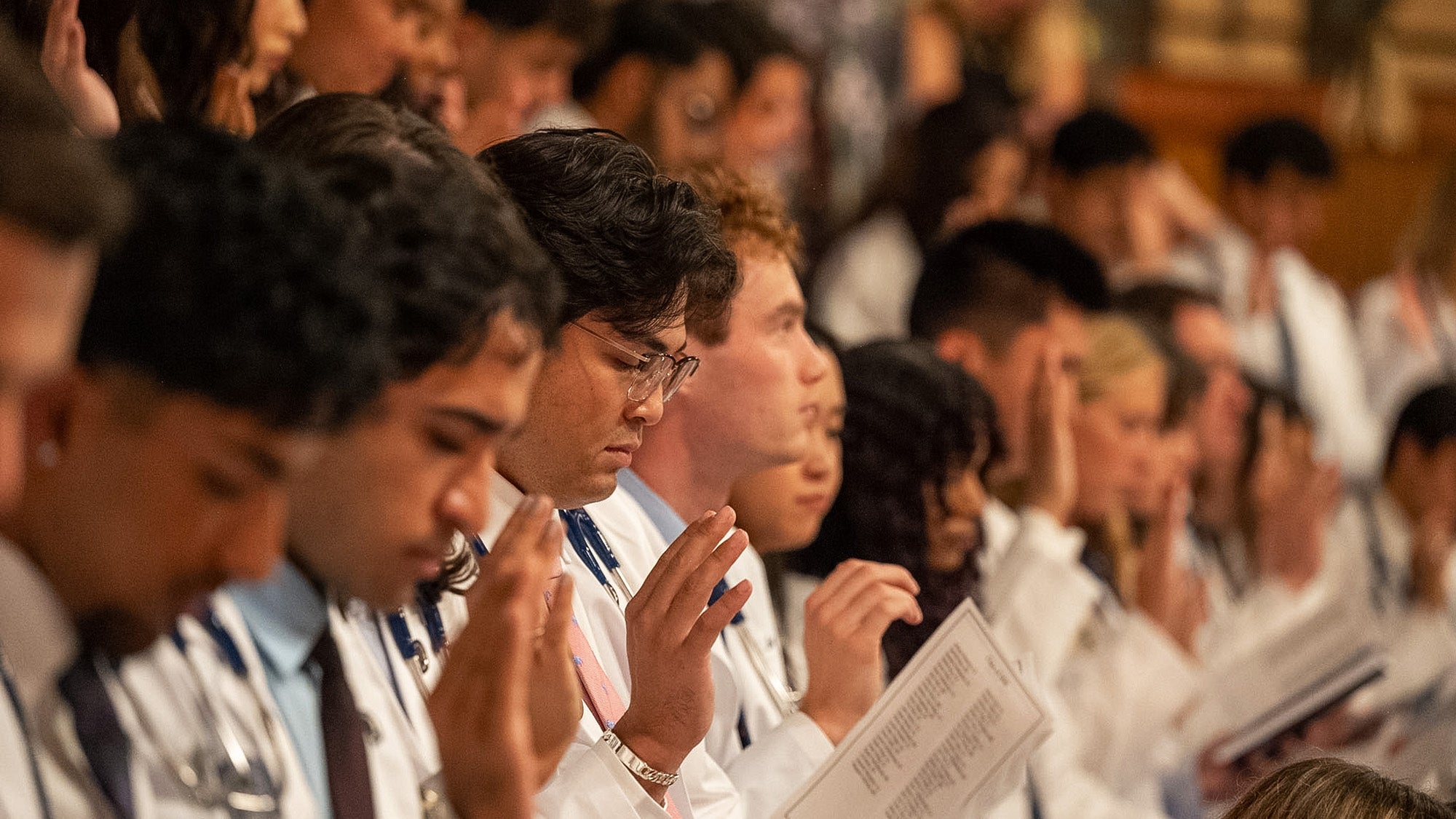
Rooted in Service and Healing: Georgetown School of Medicine Welcomes the Class of 2030
Watch Highlights From This Year’s White Coat Ceremony
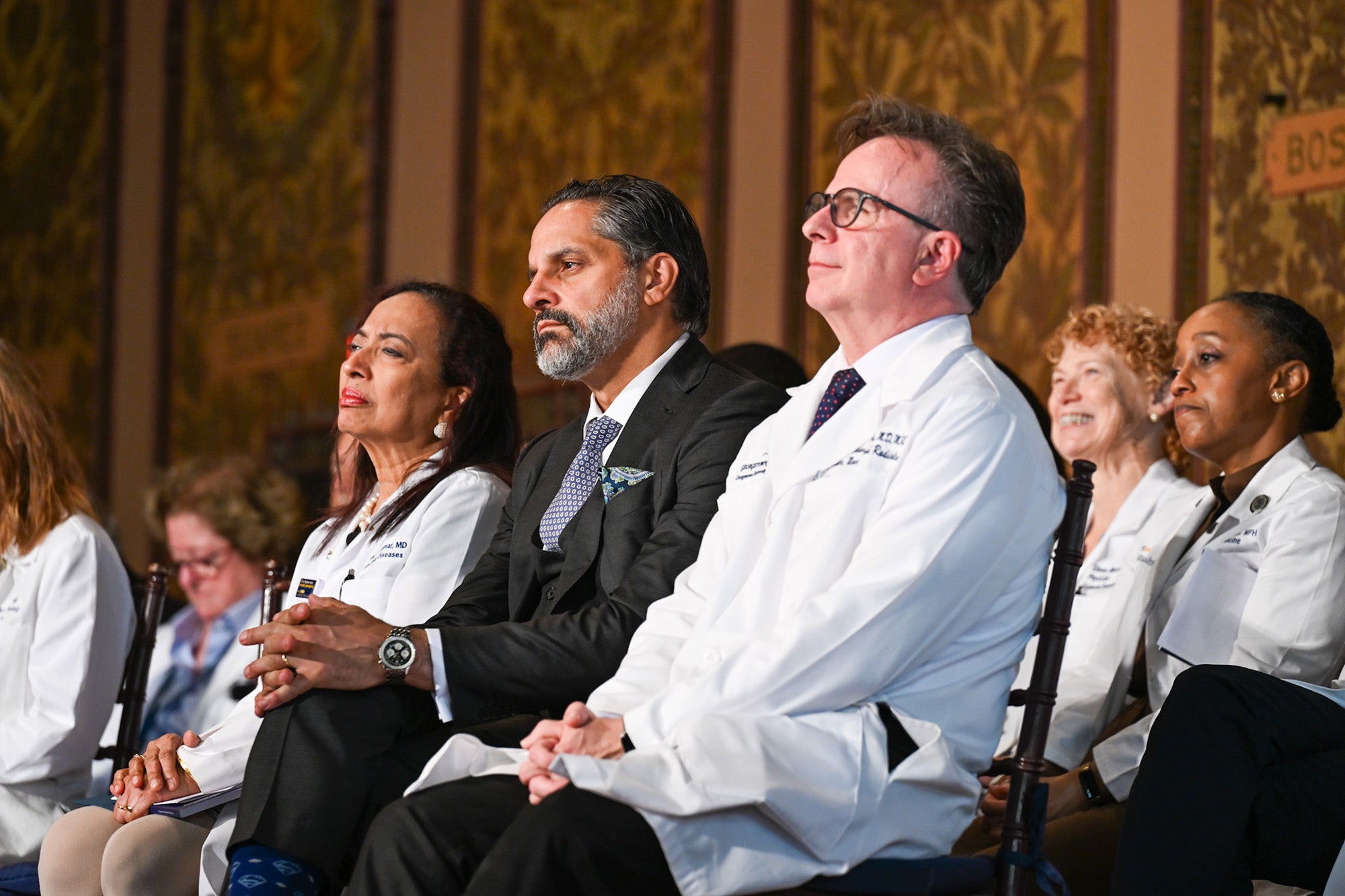
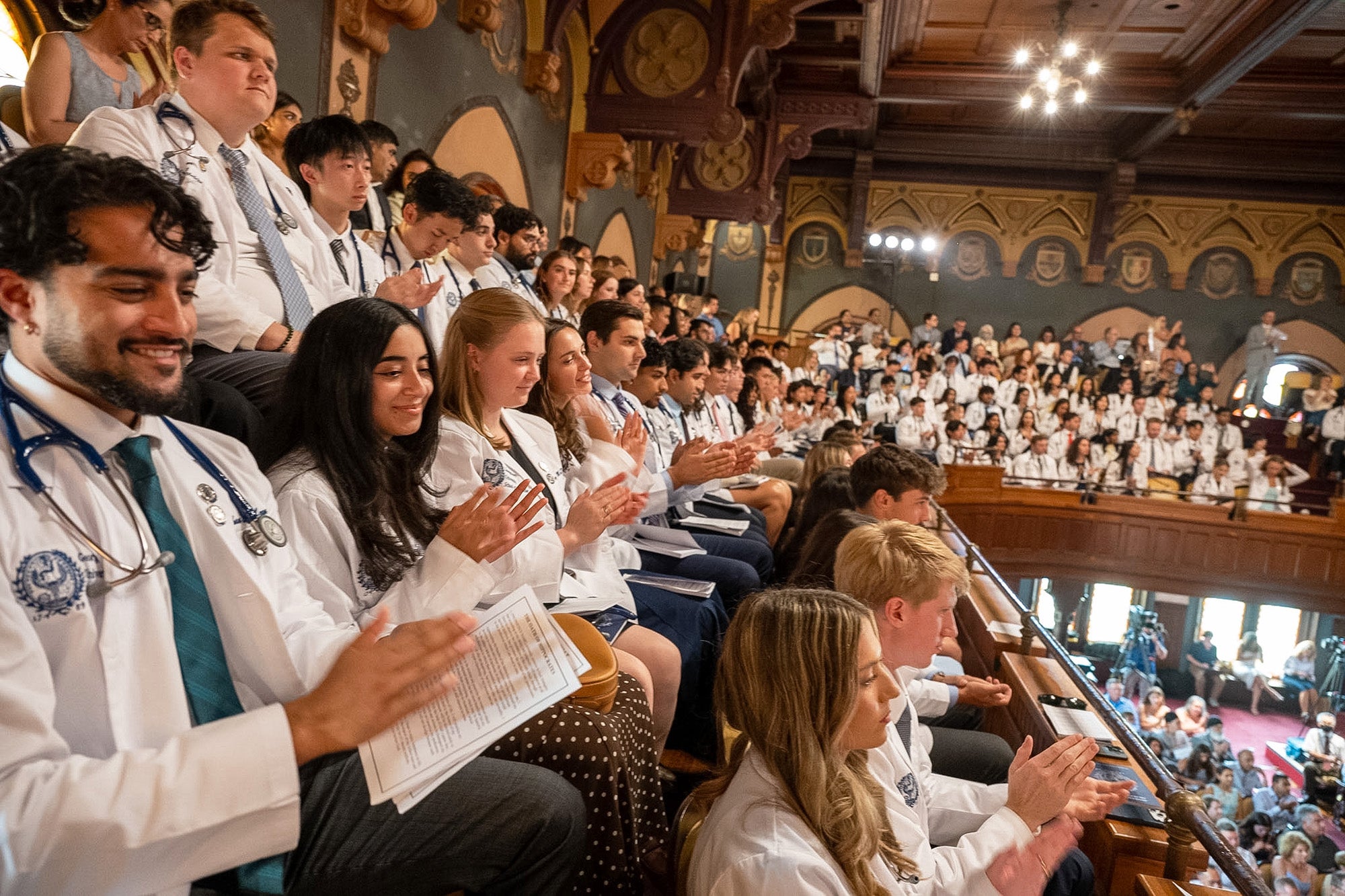
(August 12, 2026) — Inside the historic, wood-paneled Gaston Hall, the values defining a Georgetown medical education took center stage as more than 200 incoming students gathered for this year’s White Coat Ceremony. The annual Georgetown tradition for everyone entering medical school, held on August 7, served as more than a symbolic welcome into the profession; it was an explicit call to embrace cura personalis (care for the whole person), selfless service, and the moral responsibilities of healing.
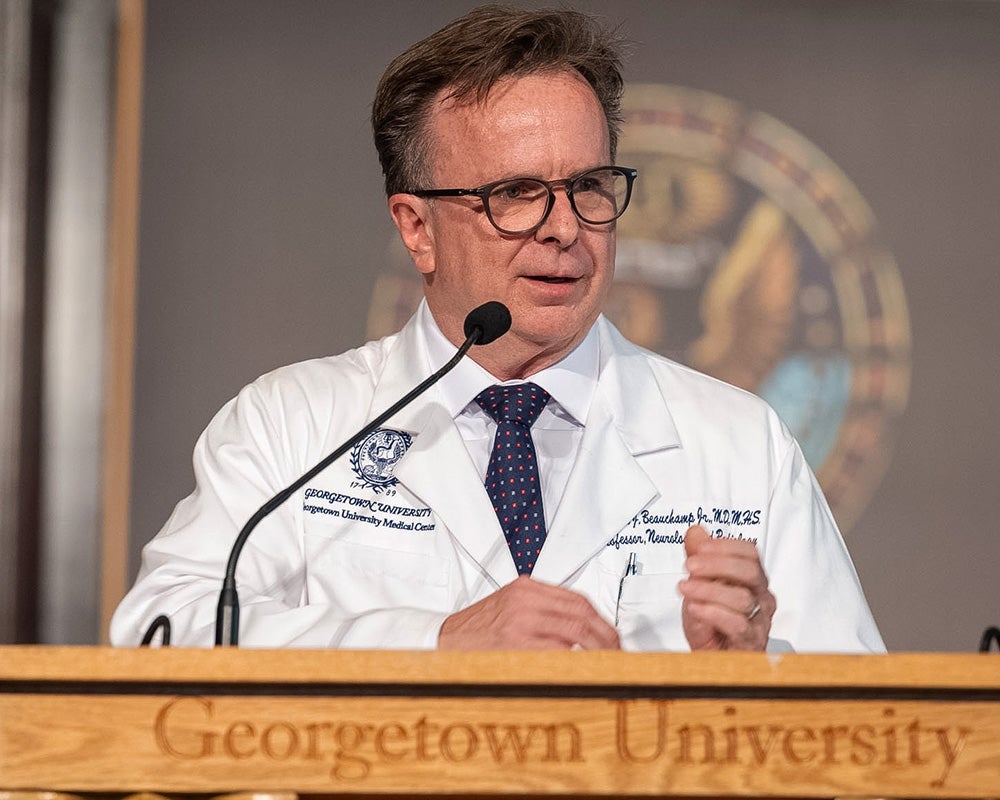
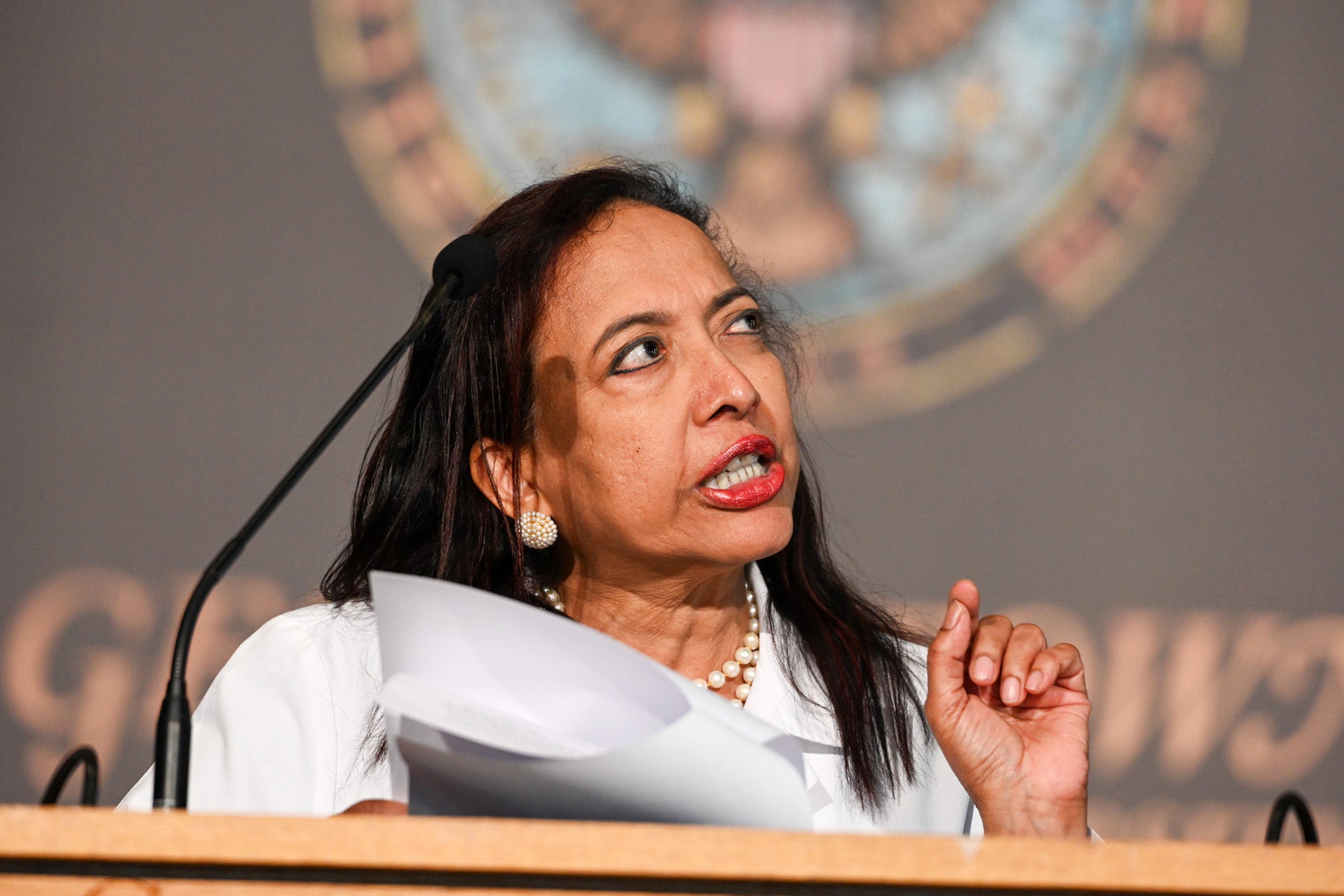
Norman Beauchamp, MD, MHS
In a world where medical education often focuses on clinical metrics, Georgetown’s ceremony emphasized the school’s focus on character, community and human dignity. From the opening remarks, speakers reminded the Class of 2030 that wearing the white coat means answering a calling higher than individual achievement.
“Your coat is far more than a garment,” said Norman Beauchamp, MD, MHS, executive vice president for health sciences and executive dean of the School of Medicine. “It is a visible pledge to your patients, your colleagues, and yourselves. It tells the world that you are joining a profession in which science and compassion must walk hand in hand.”
A Distinct and Diverse Class Committed to Service
The ceremony’s focus on service strongly resonated with the incoming cohort. Selected from a competitive pool of nearly 15,000 applicants, the new class brings an extraordinary breadth of life experiences with them.
Geographically, the class represents the nation and the world. California leads with 55 students, followed by Virginia (23), Maryland (18), New York (14), Pennsylvania (10), and Washington, D.C. (9). International students from Australia, China, Ethiopia, Japan and South Korea have also joined the community.
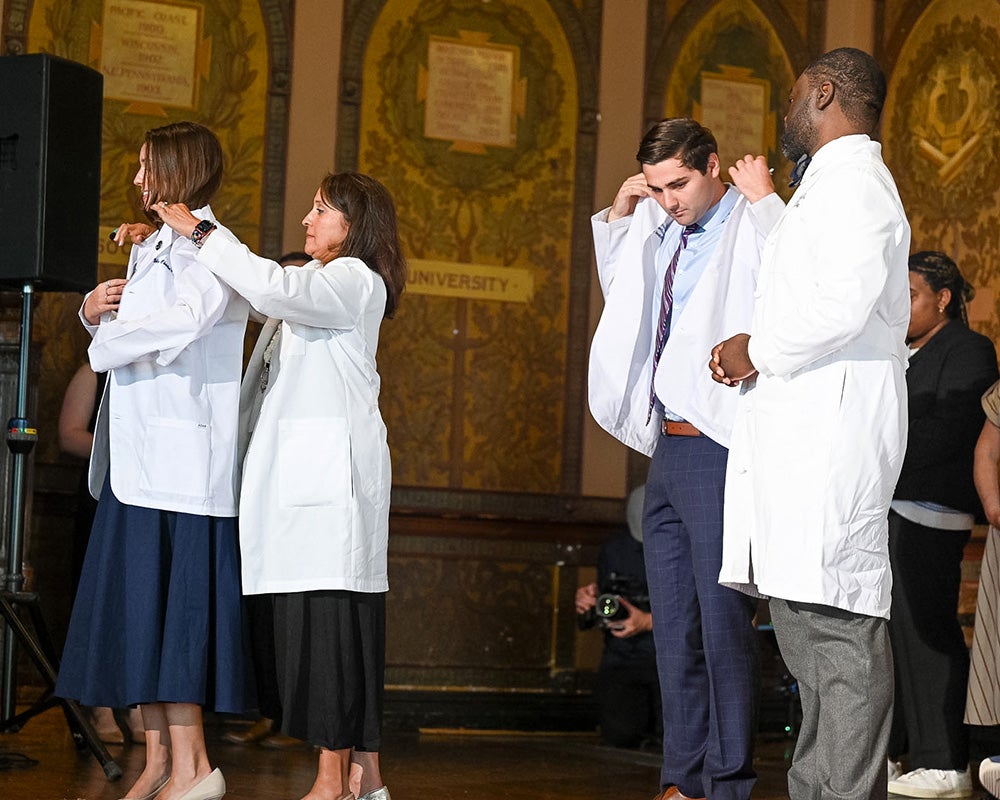
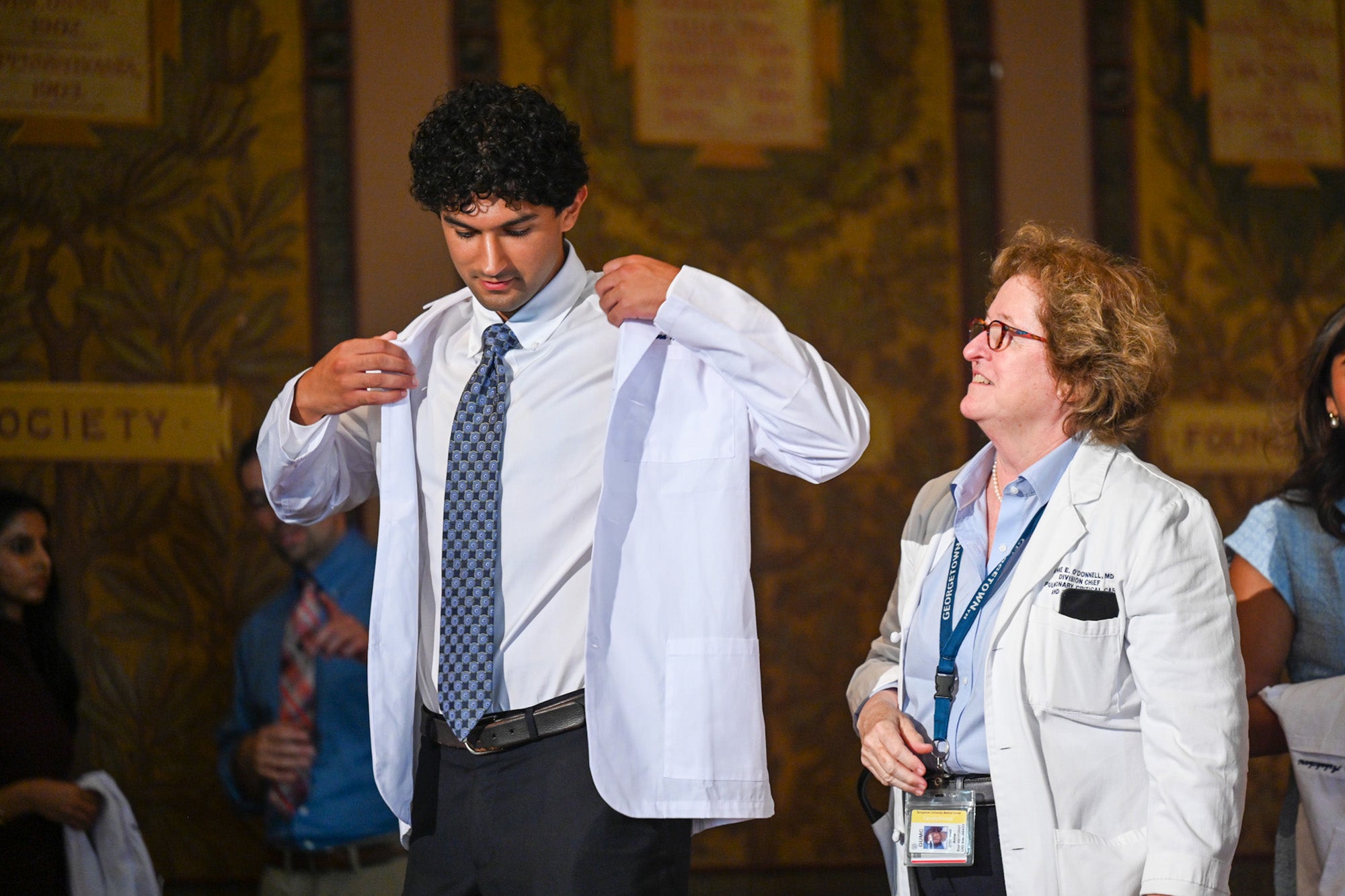
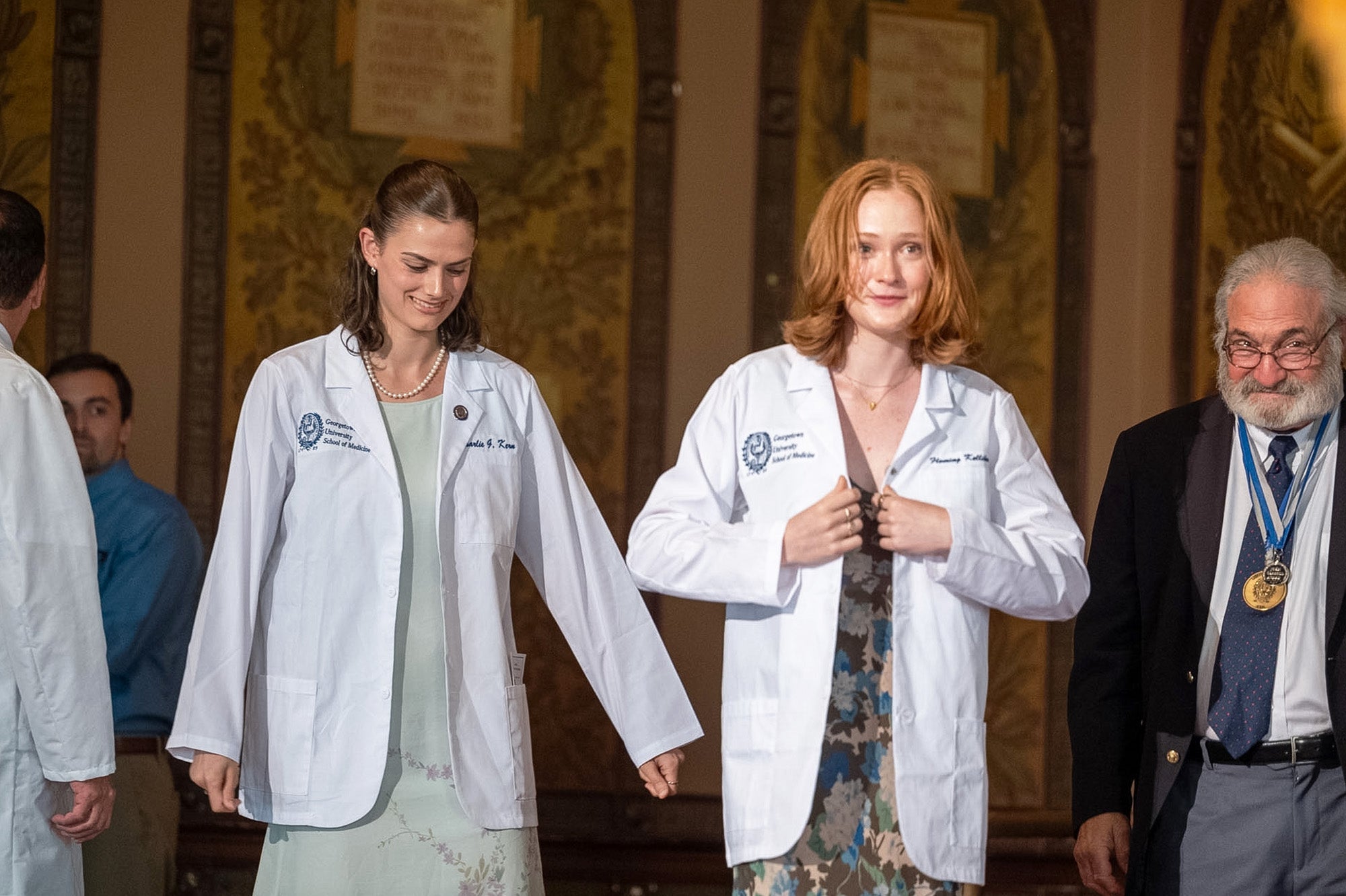
Faculty members helped students don their white coats.
Beyond their academic achievements, members of the Class of 2030 have already demonstrated a commitment to service and human connection through roles as EMTs, mental health advocates, systems engineers, bookstore managers, teaching assistants, pianists, woodworkers, animal care technicians, authors and competitive dancers.
For many, Georgetown’s distinct mission was the decisive factor in choosing where to attend medical school.
“Georgetown has such a focus on service, and you feel surrounded by people that share that value,” said Ethan Nguyen (M’30).
For non-traditional students like Jayneel Patel (M’30), the shift to medicine was driven directly by a desire to live out those values. “My wife calls this my midlife crisis,” Patel said. “I’m in my 40s. I found my career in engineering rewarding but not fulfilling, so I started to reflect at age 40 and basically took the advice I would have given my children: to do something about it. I went back and took premed requirements, studied for the MCAT, and here I am starting medical school. I’m looking forward to a career focused on serving others.”
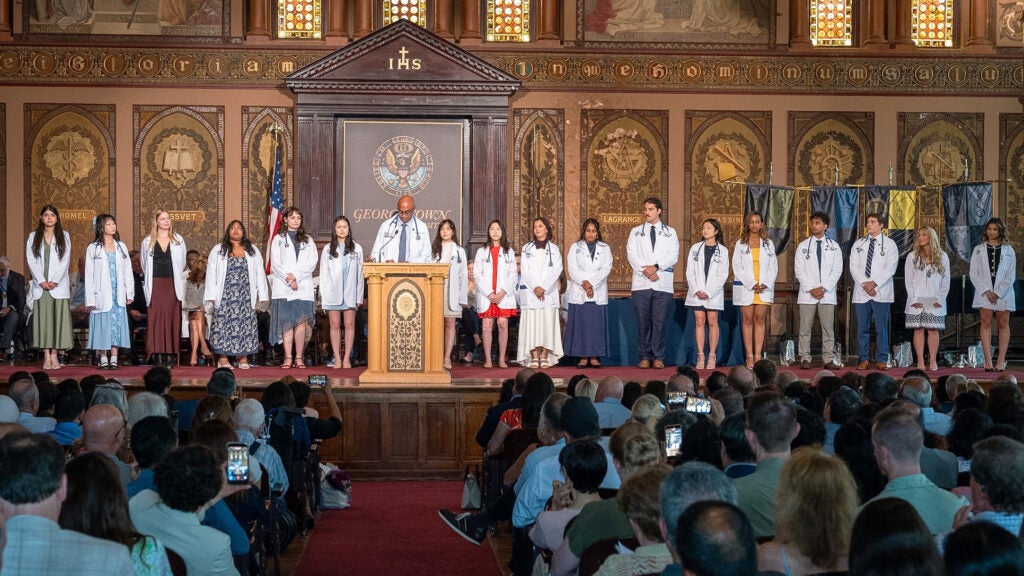
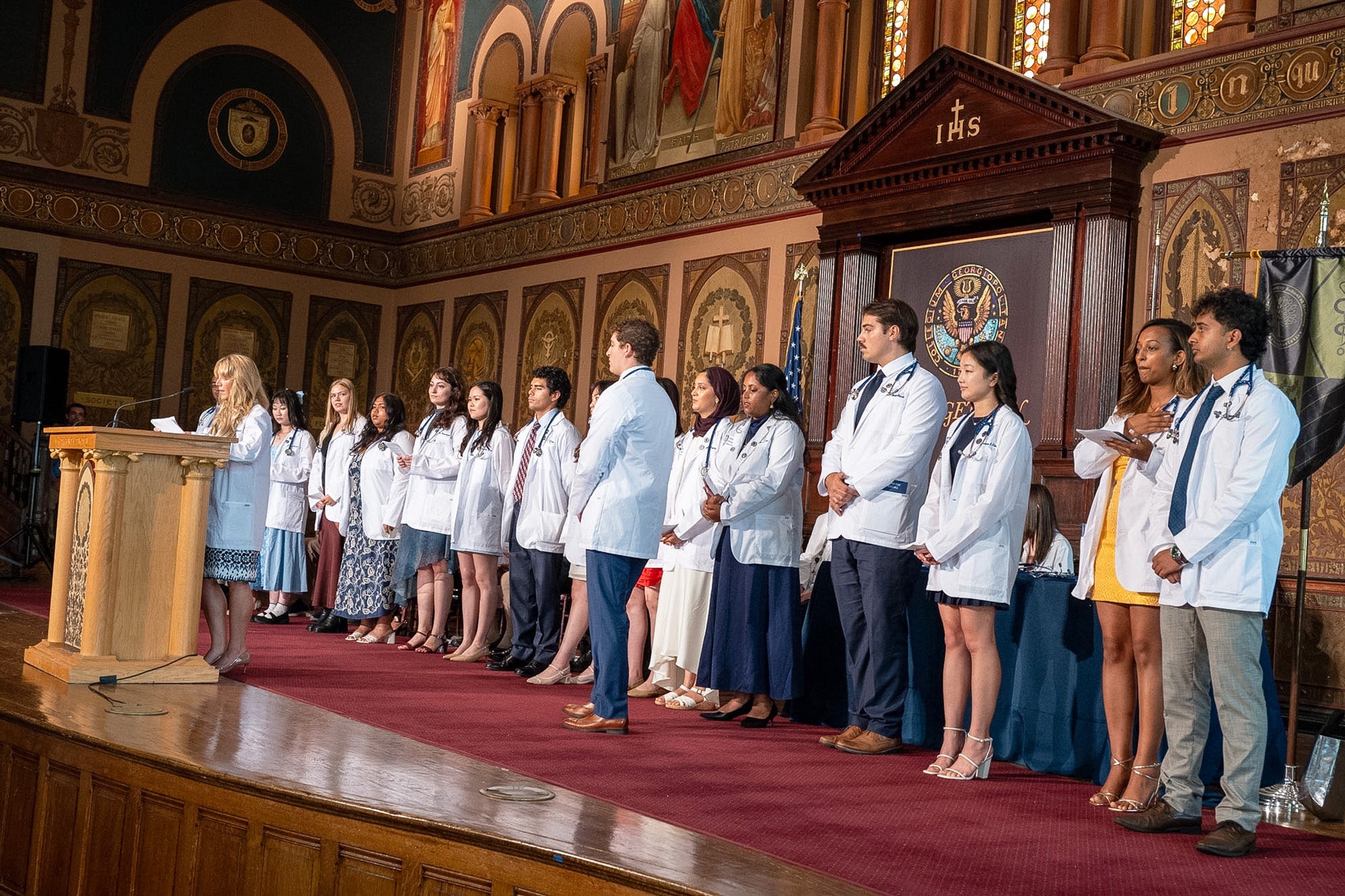
Jayneel Patel (M’30), pictured at the podium, contributed to the recitation of the Hippocratic Oath in various languages.
Words of Wisdom: The ‘Pockets of Hoya Letters’
As students stepped across the stage to receive their white coats, generously funded by alumni donations, they reached into their pockets to discover a tangible connection to the network of Hoyas waiting to support them: a handwritten note from a School of Medicine alum who once stood in their shoes.
The gesture was part of the expanded Pockets of Hoya Letters initiative, where every member of the Class of 2030 received a personal welcome. These letters wove the spirit of cura personalis directly into the fabric of the day. Alumni offered practical wisdom on navigating the intense years ahead, urging students to view self-care as essential to caring for others.
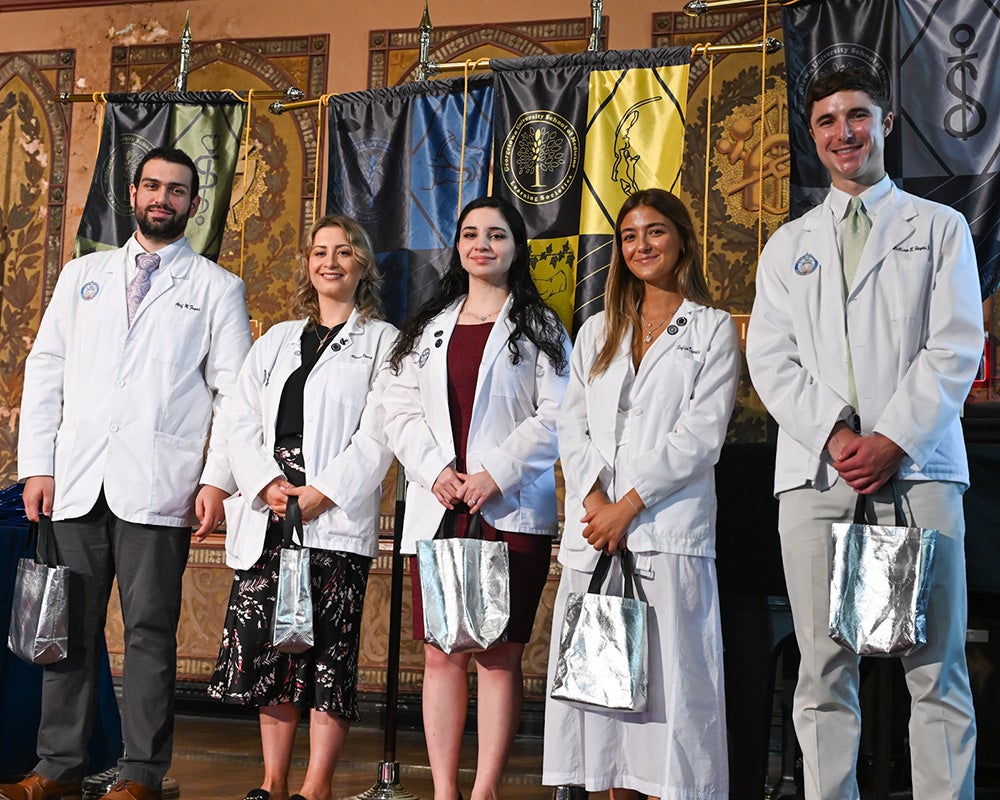
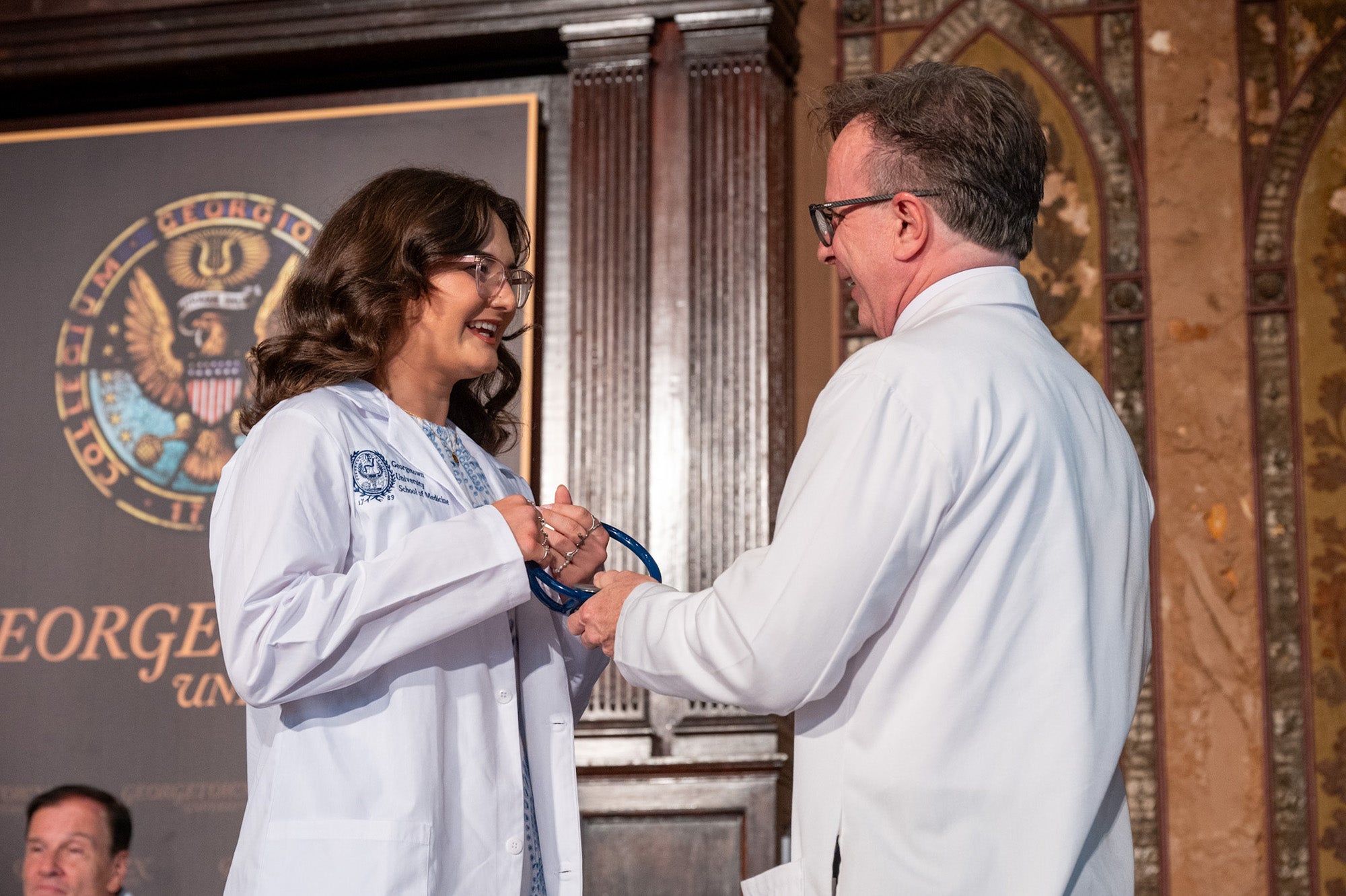
Representatives from each of the school’s Learning Societies presented pins to the incoming students.
Anthony Belotto, MD (M’13), cautioned against burnout. “If I could offer you one piece of advice, it would be this: do not confuse self-sacrifice with excellence. Medicine often celebrates those who sleep the least, never say no, and push themselves beyond their limits. But a physician who has exhausted themselves is not a better physician — they are simply exhausted.”
Other alumni emphasized the lifelong community and humility at the heart of a Georgetown education. Brian McCall, MD (M’99), reminded students that “the friendships you make here will outlast the anatomy exams, the boards, even the long hours on rotations at the hospital.” Daniela Hernandez, MD (M’26), encouraged students to remember that their worth “is not defined by a test score, evaluation or comparison to someone else.”
For GEMS scholars and nontraditional students, the messages offered deep validation. Matthew Luckman, MD (M’26), wrote: “As a GEMS and School of Medicine alum, I can promise you that Georgetown will become so much more than a place where you study medicine. Always remember that you belong here — you earned this.”
Anchored in Tradition and Jesuit Values
Throughout the ceremony, university leaders reiterated Georgetown’s commitment to holistic education and moral leadership.
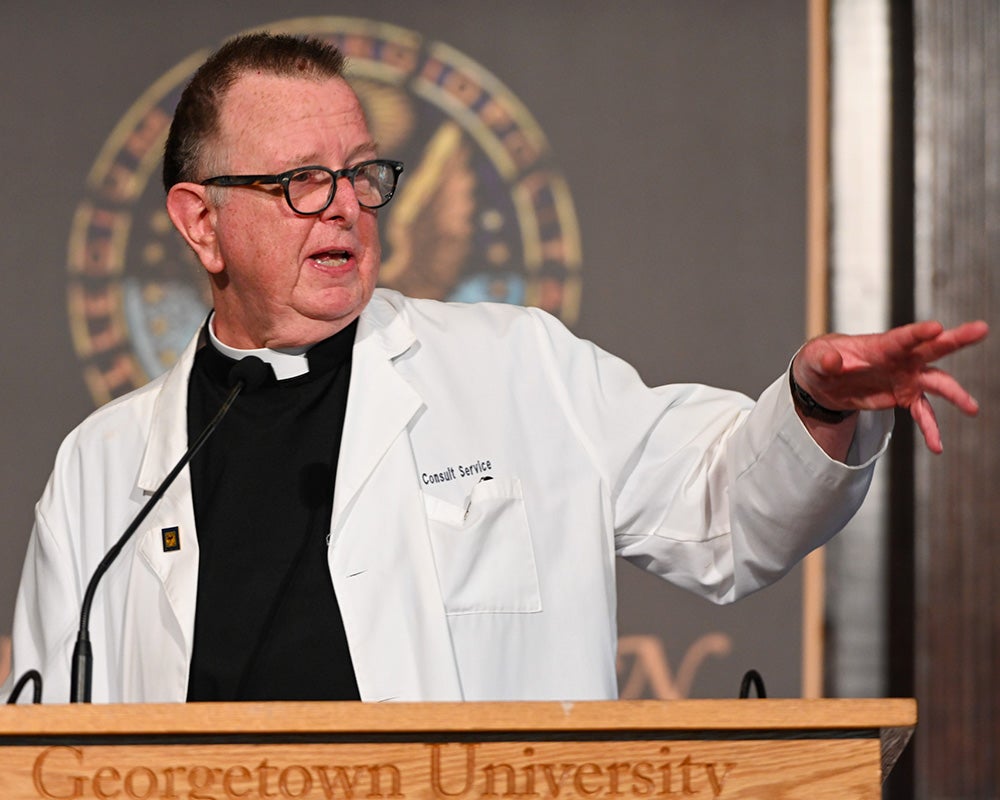
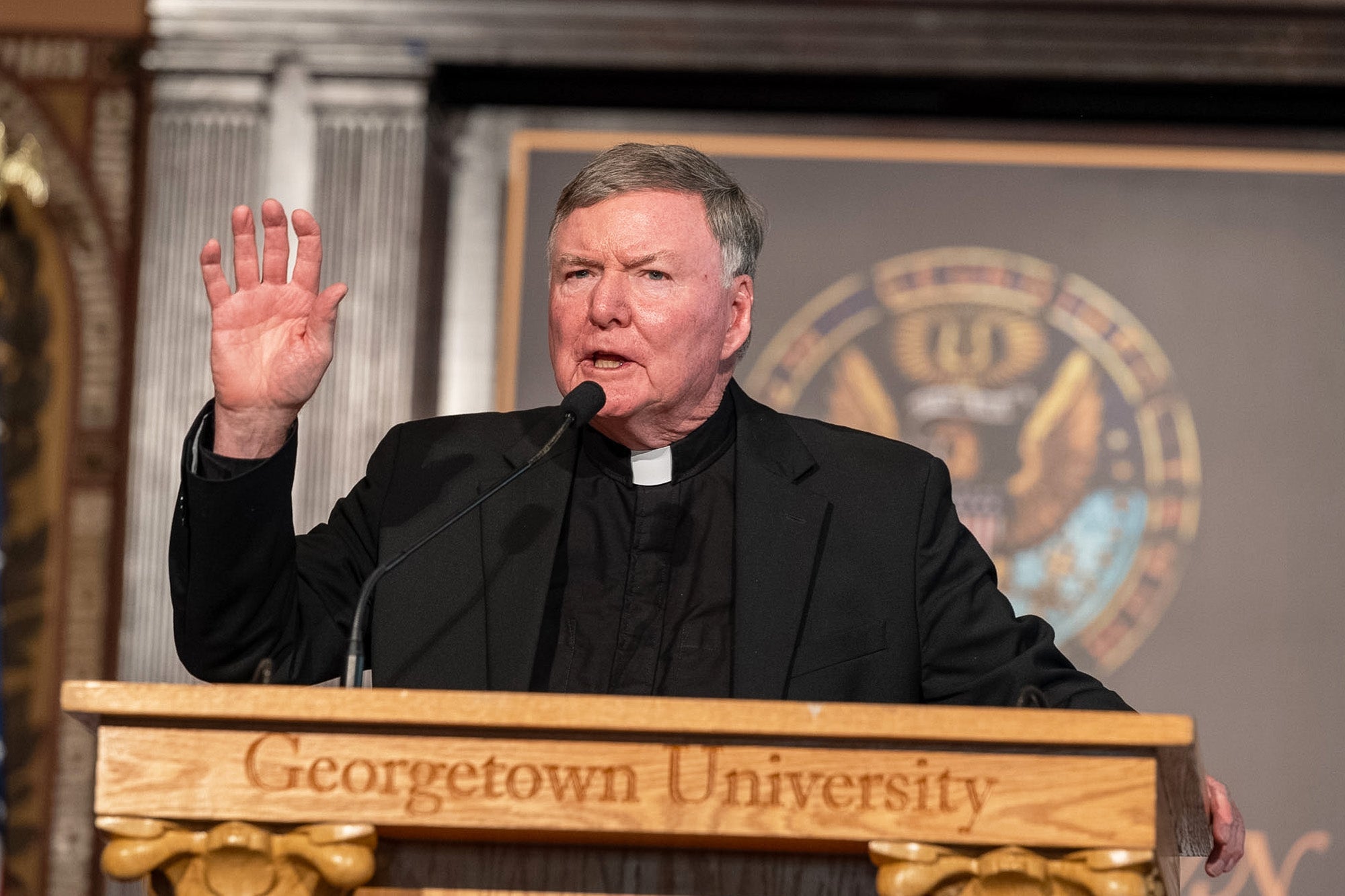
Fr. Myles Sheehan, SJ, MD
Fr. Myles Sheehan, SJ, MD, director of the Pellegrino Center for Clinical Bioethics, delivered the Edmund Pellegrino Professionalism Lecture, framing practicing medicine as a moral calling grounded in human dignity. Following his address, John DiBello, MD (M’26), and Abigail Escobar (M’27) introduced “Answering the Healer’s Call,” a pocket-sized book produced by the pair that focuses on Georgetown’s spiritual values as a guide for the rigors of medical training. Each student was given a copy of the book along with their Learning Society pins.
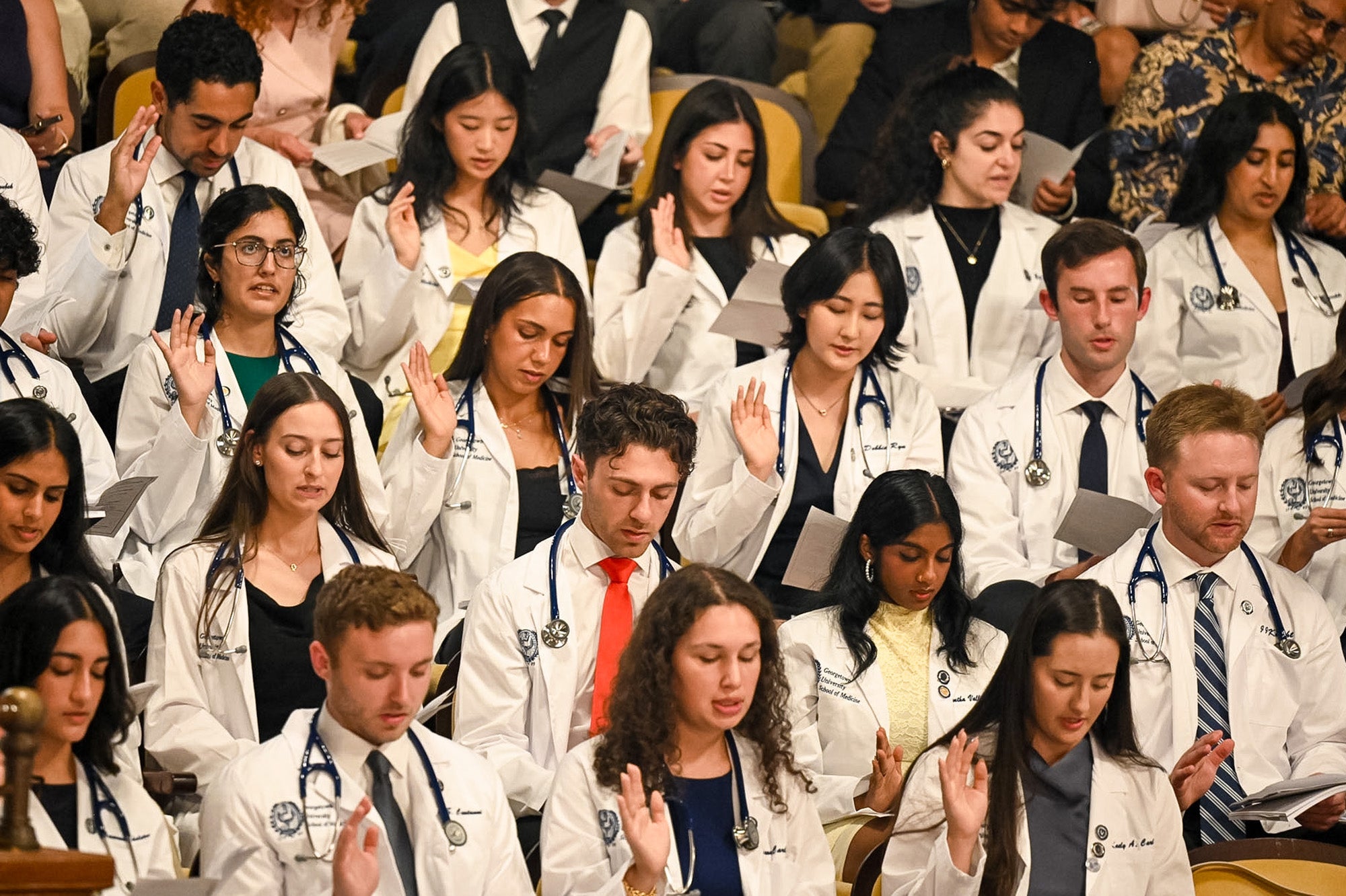
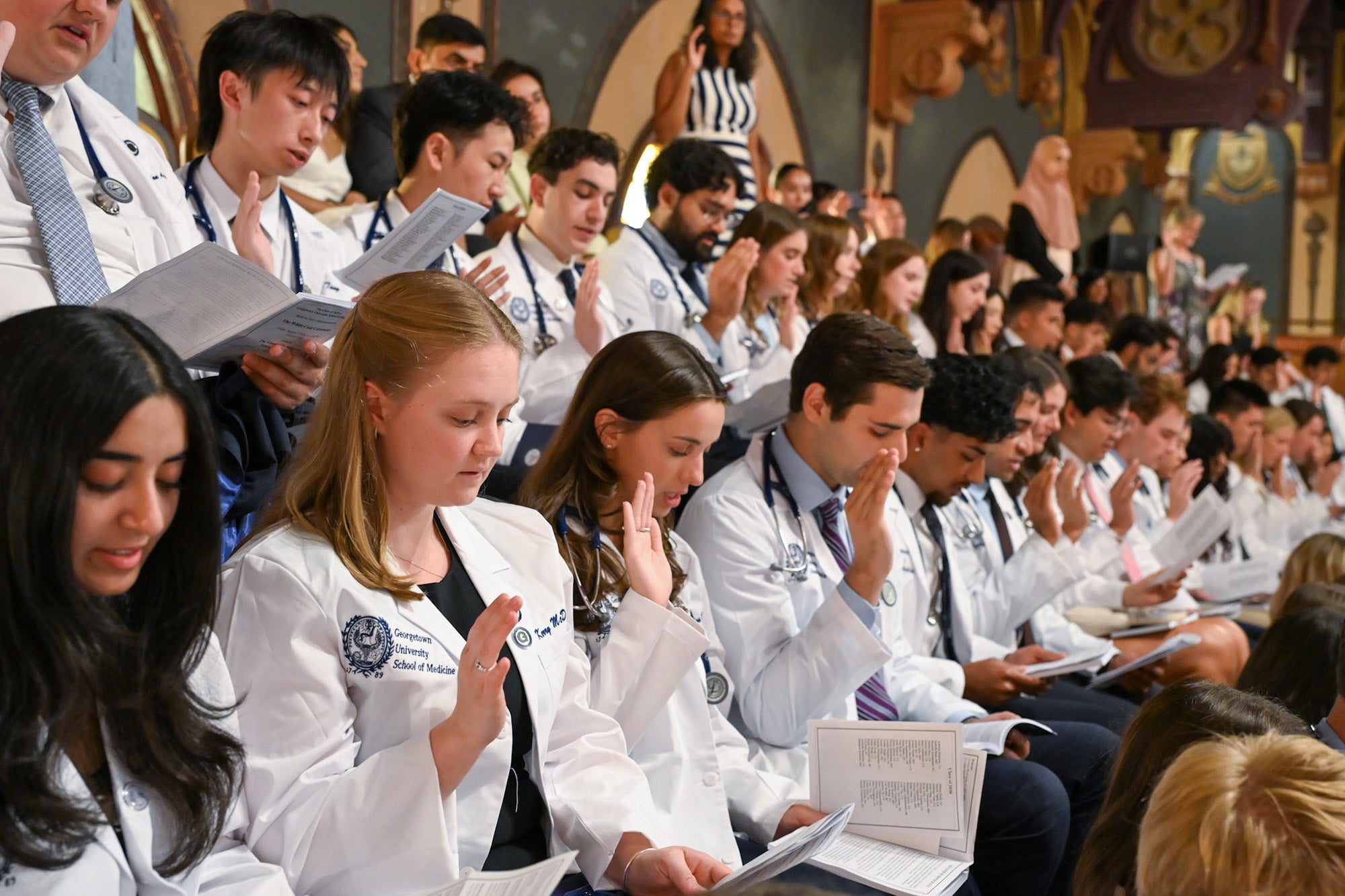
After the coating, students were led through a recitation of the Hippocratic Oath, which was subsequently echoed in multiple languages by students, a powerful display of the class’s global breadth.
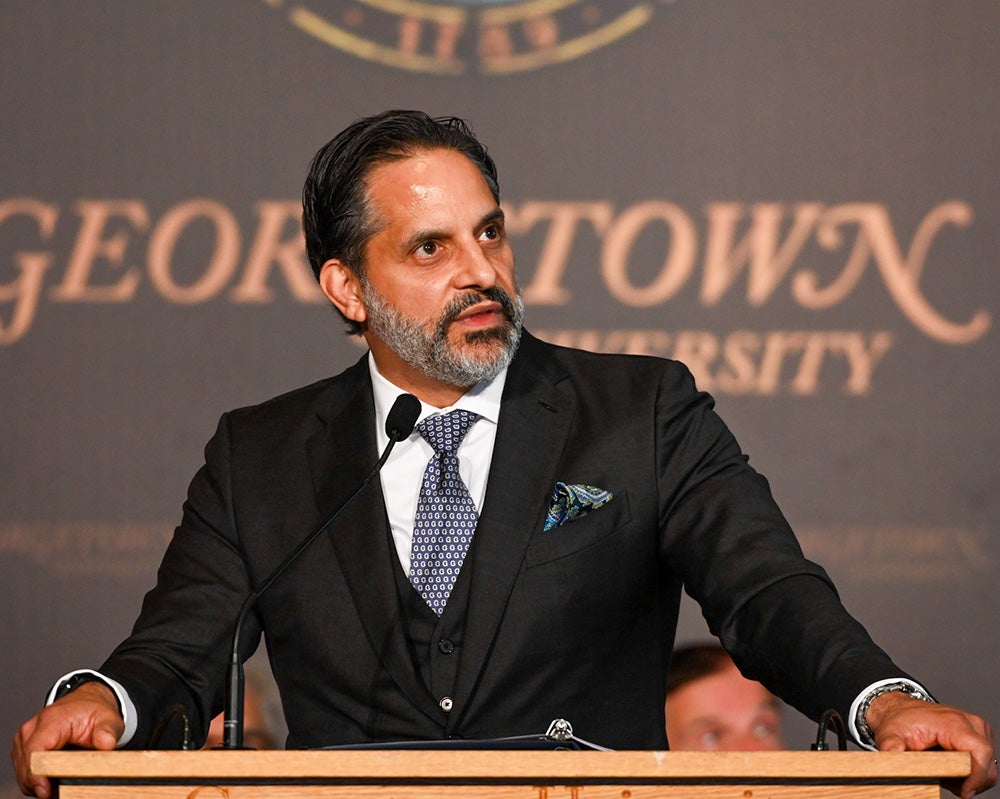
Eduardo Peñalver, JD
Georgetown University President Eduardo Peñalver, JD, then addressed the incoming students, drawing on the poetry of philosopher John O’Donohue to describe the White Coat Ceremony as a “threshold” into a new identity rooted in trust and responsibility.
“‘A threshold is not a threat,’ [O’Donohue] says. ‘It is an invitation and a promise,’” Peñalver noted, reminding students that their coats represented what the philosopher called “visible signs of invisible grace,” tangible proof of the support from families, faculty and the global alumni network cheering them on.
Moving Forward Together
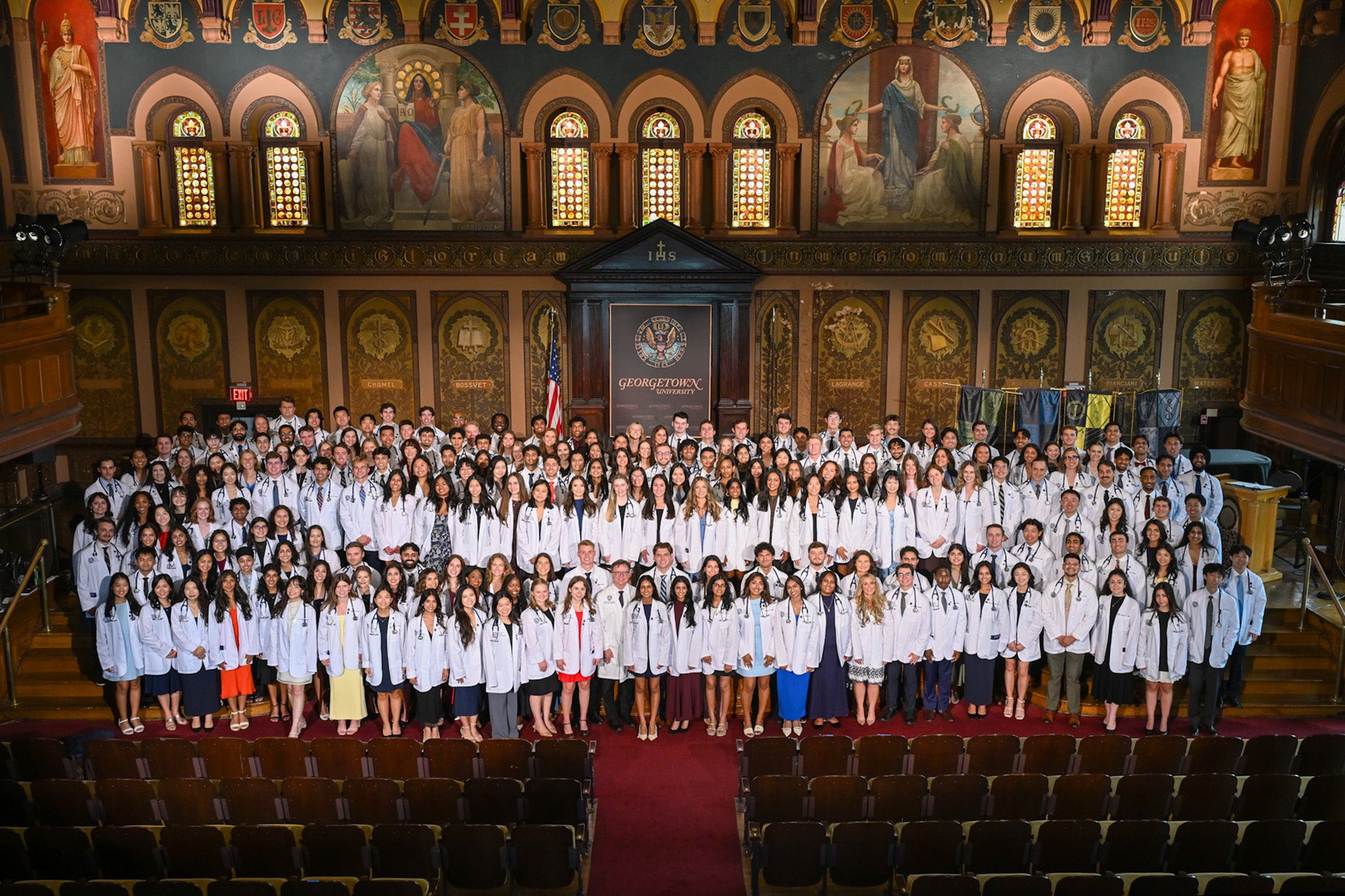
Following the benediction by Fr. James Shea, SJ, the Class of 2030 gathered on stage for their official class photo before joining loved ones outside for cookies and lemonade.
For the new students, the day was a profound reminder of both the responsibility ahead and the immense gratitude owed to those who helped them reach this moment.
Noah Overbeck (M’30) reflected on the shared debt of gratitude for the day. “Walking across the stage … it felt like a moment where so many people have given so much to me to get me to this point. I owe it to them to put in the work to improve not only their lives but everyone in my community.”
As celebrations wrapped up and the journey officially began, the anticipation for what lies ahead was simple and clear. “I’m just excited to start the year,” said Michael Nguyen (M’30).
End of carousel collection.
More Scenes from the Ceremony
Heather Wilpone-Welborn
GUMC Communications