Policy and Procedures for Reporting Mistreatment
We will create and sustain a learning environment that fosters:
Mutual Respect
Trust
Honesty
Collegiality
Compassion
Accountability
The full policy is available in the Student Handbook.
Behaviors that Undermine the Learning Experience
Abuse
- Unprofessional criticism primarily intended to belittle, embarrass, or humiliate.
- Required to perform menial tasks with intent to humiliate or degrade.
- Asked to perform personal services.
Discrimination and Harassment
- Objectively intimidating, hostile, or offensive conduct (verbal or physical) that denigrates or shows hostility or aversion to an individual on the basis of a protected category outlined below.
- Conduct in question must interfere with a person’s ability to participate in the University’s employment or educational programs.
- Protected Categories: age, color, disability, family responsibilities, gender identity and expression, genetic information, marital status, national origin and accent, personal appearance, political affiliation, pregnancy, race, religion, sex, sexual orientation, source of income, veteran’s status, or any other factor prohibited by federal and/or District of Columbia law.
Avenues to Report Mistreatment
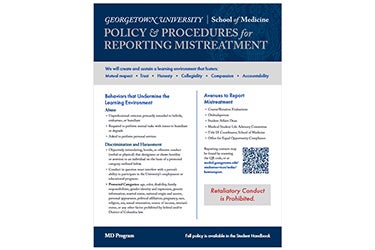
Download a Summary of Policies and Procedures for Reporting Mistreatment
Our Commitment to a Culture of Respect
Georgetown University School of Medicine is an institution rooted in the Jesuit ideal of cura personalis, care of the whole person. The School of Medicine is committed to creating and sustaining an educational environment that fosters the values and virtues of mutual respect, trust, honesty, collegiality, compassion, and accountability. Such values and virtues are especially critical to effective relationships between teachers and learners, which are a significant force in the intellectual and ethical formation of future physicians. A teacher’s function as a role model for students is fundamental to the educational mission of a medical school.
Behaviors that fail to reflect and embody these values and virtues not only undermine the efficacy of the teacher-learner relationship, they also threaten the integrity of the educational mission itself. The full Teacher-Learner Relationship & Procedures to Address Student Mistreatment Policy is located in the Student Handbook. The School of Medicine takes reports of mistreatment very seriously and acts swiftly to investigate and take actions appropriate to the scenario.
A medical student who feels that they have witnessed or experienced any type of bias, harassment, or mistreatment in the learning environment is encouraged to report it through the avenues noted above. When reporting anonymously through MSLAC or New Innovations, students should be as specific as possible in the reports that they make (location, service, date of occurrence, names/roles of individuals involved or present, etc.). Please note that anonymous reporting can limit the ability of the administration to act due to lack of specificity and ability to follow up with the person making the report. Reports made through anonymous avenues are nevertheless taken very seriously, and investigated thoroughly, by the School of Medicine.
Stop, Talk, Roll
Stop, Talk, Roll (STR) is a communication guidance tool that has been designed to provide suggested phrases and approaches for medical students and residents to addressing particular scenarios and diffuse tense communication exchanges with a wide range of stakeholders. STR training and guidance will be provided to medical students, residents and medical staff this coming fall.
STR also provides pathways for seeking out help and support to navigate the scenarios, which include seeking out support from your residency program leadership, including: chief residents, program directors and associate program directors.